
Safe Usage Guidelines for Attic Ladders in Residential and Commercial Buildings
Full Content
Attic ladders are designed to provide safe vertical access to upper storage spaces. However, safe operation depends not only on product design but also on correct user behavior and installation conditions.
Many ladder-related accidents are caused by improper usage rather than structural failure. Understanding safe operation principles is essential for both homeowners and commercial users.
1. Understanding Attic Ladder Safety
A folding attic ladder is a load-bearing system designed for repeated human use. Unlike portable ladders, it is fixed to a structural frame and must support both static and dynamic loads.
Safe usage depends on:
- Correct installation
- Proper load distribution
- User behavior during climbing
2. Correct Climbing Method
To ensure safety during use:
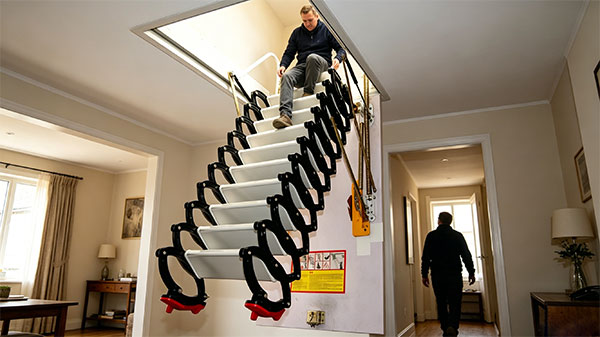
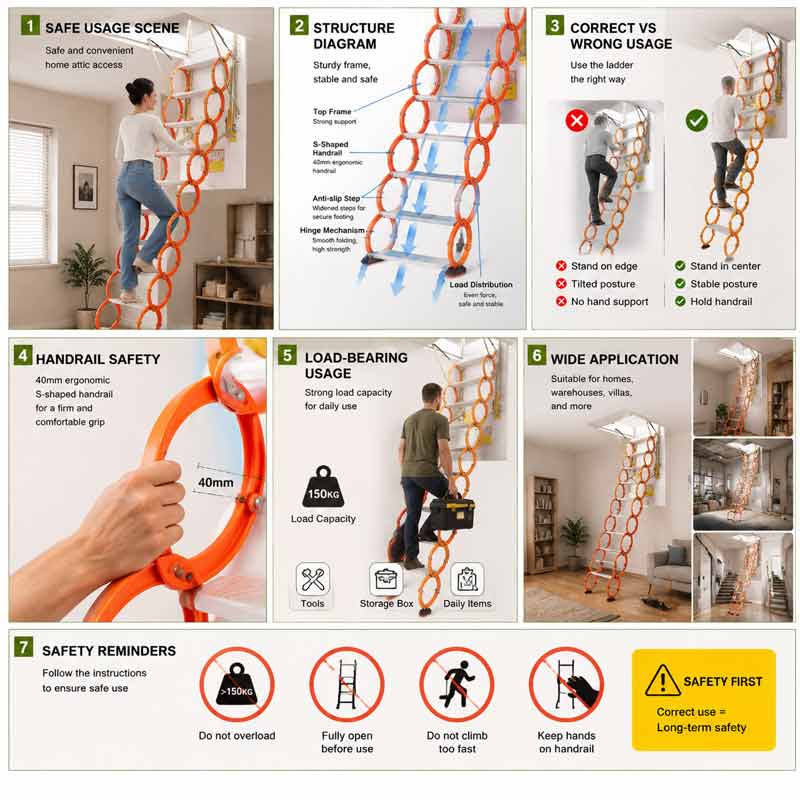
- Always face the ladder when climbing up or down
- Maintain three-point contact (two hands + one foot)
- Do not rush movement during ascent or descent
- Avoid jumping or skipping steps
Stable movement reduces load shock on the structure.
3. Load Distribution Awareness
One of the most common mistakes is ignoring total load weight.
Total load includes:
- User body weight
- Hand-carried items
- Stored equipment or boxes
Even if a ladder supports 350kg or 550kg, dynamic movement can temporarily increase stress.
Heavy-duty ladders distribute load more efficiently during use.
4. Importance of Fully Opening the Ladder
Before use, ensure the ladder is fully extended and locked into position.
Partial opening may cause:
- Uneven force distribution
- Structural instability
- Increased hinge stress
A properly opened ladder ensures maximum load safety.
5. Step Safety and Foot Placement
Correct foot placement is critical.
Users should:
- Step in the center of each tread
- Avoid stepping on edge areas
- Maintain steady weight distribution
Thicker steps (such as 28mm–33mm designs) provide better stability.
6. Handrail Usage for Stability
Handrails should always be used when available.
A 40mm ergonomic handrail improves:
- Grip strength
- Balance control
- Safety during load carrying
- Confidence during climbing
7. Environmental Safety Considerations
Different environments require different caution levels:
Indoor Use
- Ensure floor area is clear
- Avoid slippery surfaces near ladder base
Outdoor Use
- Avoid use during rain or high wind
- Check corrosion conditions regularly
- Ensure stable ground support
8. Common Unsafe Practices
Avoid the following behaviors:
- Overloading beyond rated capacity
- Using ladder with visible damage
- Rapid climbing with heavy items
- Using ladder without full extension
- Ignoring maintenance issues
9. Choosing the Right Ladder Improves Safety
Safety is directly related to product quality.
Key safety-related design factors:
- Load capacity (350kg–550kg)
- Step thickness (28–33mm reinforced design)
- Handrail width (40mm ergonomic design)
- Structural material (steel vs aluminum alloy)
Better design reduces risk during long-term use.
Conclusion
Attic ladder safety depends on both product design and user behavior. By following correct usage guidelines and choosing a properly engineered ladder system, users can significantly reduce risk and improve long-term reliability.
For frequent or commercial use, heavy-duty aluminum alloy systems provide higher safety margins and smoother operation.