
Understanding Different Types of Attic Ladders for Modern Buildings
Understanding Different Types of Attic Ladders for Modern Buildings
Attic ladders are not a one-type-fits-all product.
Different building structures, usage frequencies, and installation conditions require different ladder systems.
Choosing the wrong type may lead to installation failure, poor usability, or reduced safety.
This article explains the main types of attic ladders used in residential and industrial projects, and how to select the right one for your application.
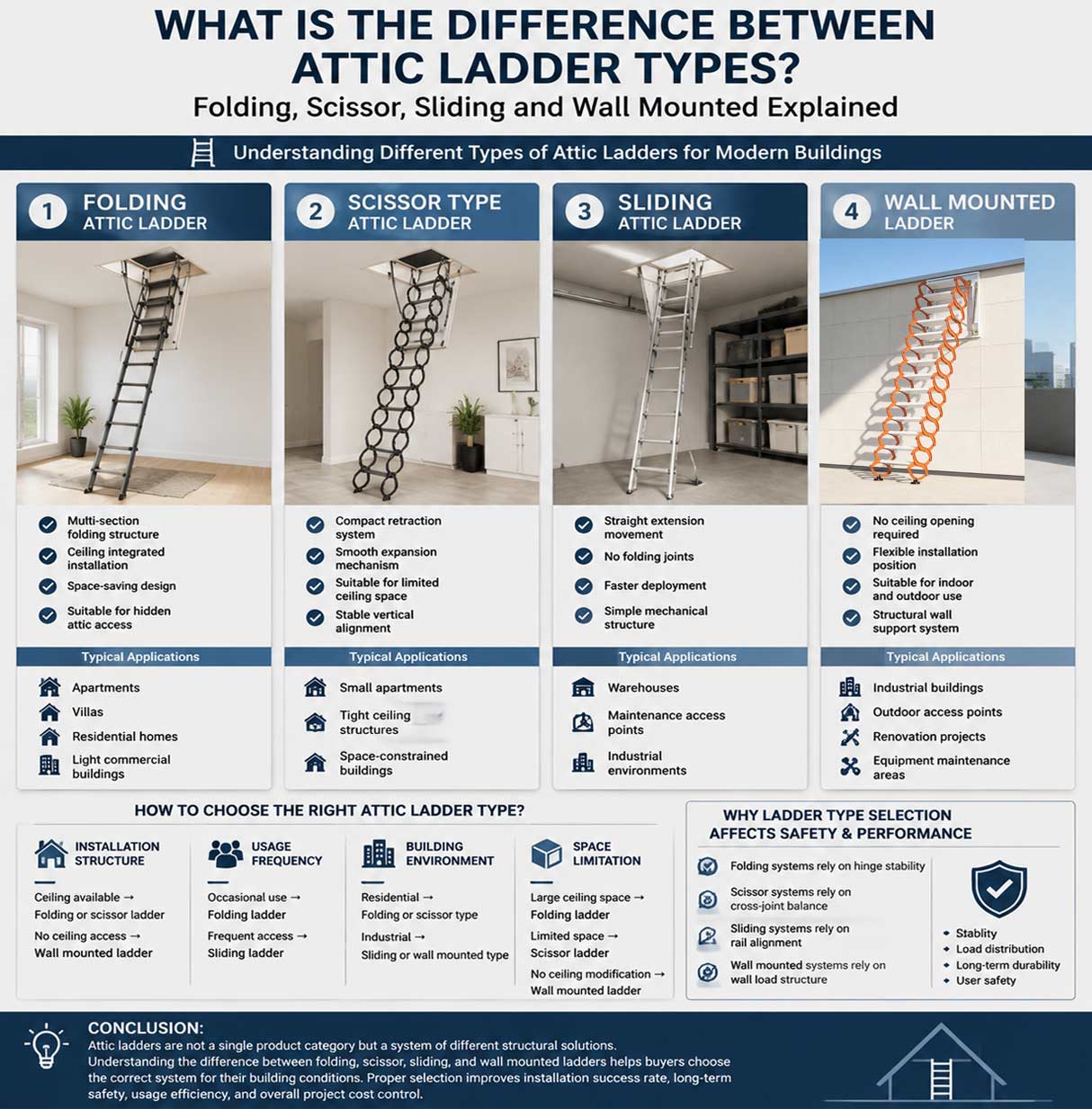
1. Folding Attic Ladder (Most Common Type)
Folding attic ladders are the most widely used solution in residential buildings.
They are designed to fold into multiple sections and store inside the ceiling space when not in use.
Key characteristics:
- Multi-section folding structure
- Ceiling integrated installation
- Space-saving design
- Suitable for hidden attic access
Typical applications:
- Apartments
- Villas
- Residential homes
- Light commercial buildings
This type is ideal when ceiling opening access is available.
2. Scissor Type Attic Ladder (Compact Design Solution)
Scissor attic ladders use a cross-linked metal structure that expands and contracts like a scissor mechanism.
Unlike folding ladders, they do not require multiple rigid sections.
Key characteristics:
- Compact retraction system
- Smooth expansion mechanism
- Suitable for limited ceiling space
- Stable vertical alignment
Typical applications:
- Small apartments
- Tight ceiling structures
- Space-constrained buildings
Scissor ladders are often chosen when installation space is limited.
3. Sliding Attic Ladder (Straight Extension System)
Sliding ladders operate using a telescopic or rail-based extension system.
Instead of folding, the ladder extends in a straight line.
Key characteristics:
- Straight extension movement
- No folding joints
- Faster deployment
- Simple mechanical structure
Typical applications:
- Warehouses
- Maintenance access points
- Industrial environments
Sliding systems are preferred when frequent access is required.
4. Wall Mounted Ladder (No Ceiling Opening Required)
Wall mounted ladders are a special category designed for situations where ceiling modification is not possible.
Unlike traditional attic ladders, they are installed directly onto a wall structure.
Key characteristics:
- No ceiling opening required
- Flexible installation position
- Suitable for indoor and outdoor use
- Structural wall support system
Typical applications:
- Industrial buildings
- Outdoor access points
- Renovation projects
- Equipment maintenance areas
This type is increasingly used in modern renovation projects where ceiling cutting is not allowed.
5. How to Choose the Right Attic Ladder Type
Selecting the correct ladder type depends on several factors:
1. Installation Structure
- Ceiling available → Folding or scissor ladder
- No ceiling access → Wall mounted ladder
2. Usage Frequency
- Occasional use → Folding ladder
- Frequent access → Sliding ladder
3. Building Environment
- Residential → Folding or scissor type
- Industrial → Sliding or wall mounted type
4. Space Limitation
- Large ceiling space → Folding ladder
- Limited space → Scissor ladder
- No ceiling modification → Wall mounted ladder
6. Common Buyer Mistake When Choosing Ladder Types
Many buyers only focus on price or appearance, but ignore structural compatibility.
Common mistakes include:
- Choosing folding ladder without ceiling access
- Using scissor ladder for heavy industrial use
- Selecting sliding ladder for small residential spaces
- Ignoring installation constraints
These mistakes often lead to reinstallation cost and project delay.
7. Why Ladder Type Selection Affects Safety and Performance
Each ladder type has different mechanical behavior:
- Folding systems rely on hinge stability
- Scissor systems rely on cross-joint balance
- Sliding systems rely on rail alignment
- Wall mounted systems rely on wall load structure
Incorrect selection can affect:
- Stability
- Load distribution
- Long-term durability
- User safety
Conclusion
Attic ladders are not a single product category but a system of different structural solutions.
Understanding the difference between folding, scissor, sliding, and wall mounted ladders helps buyers choose the correct system for their building conditions.
Proper selection improves:
- Installation success rate
- Long-term safety
- Usage efficiency
-
Overall project cost control
Email: info001@xxzjmachine.com
WhatsApp: +86 18737347370
Response within 2 hours during business hours
Related inquiries:Why Anti-Slip Design Is Critical for Attic Ladder Safety | Surface, Steps & StructuralProtection