
Attic Ladder Applications in Commercial and Industrial Buildings
Attic Ladder Applications in Commercial and Industrial Buildings
Expanding the Use of Attic Ladders Beyond Residential Homes
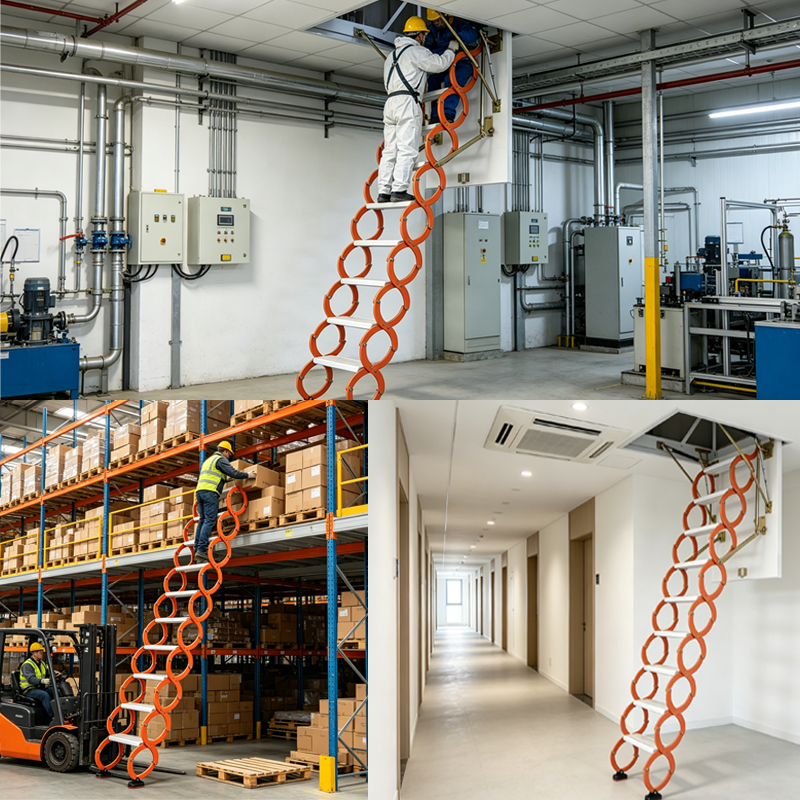
While attic ladders are commonly associated with residential buildings, their usage in commercial and industrial environments has increased significantly in recent years.
Warehouses, factories, hotels, and maintenance facilities all require safe and efficient access systems for elevated spaces.
Attic ladders provide a compact and cost-effective solution compared to permanent stair structures.
Why Commercial Buildings Need Attic Access Systems
In commercial environments, space efficiency and operational safety are critical.
Many buildings have:
- Elevated storage platforms
- Mechanical maintenance areas
- Ceiling-level equipment zones
- Utility access points
Without a proper access system, maintenance becomes inefficient and unsafe.
Attic ladders provide a practical solution without requiring large structural modifications.
Common Commercial and Industrial Applications
Warehouses
Used for accessing:
- Storage mezzanines
- Overhead inventory areas
- Equipment platforms
Benefits include fast installation and efficient space utilization.
Manufacturing Facilities
Used for:
- Machine maintenance access
- Electrical control zones
- Overhead pipelines and systems
Heavy duty ladders are preferred due to frequent usage.
Hotels and Hospitality Buildings
Used for:
- Maintenance access above ceilings
- Service corridors
- Utility inspection points
Compact folding ladders help maintain building aesthetics.
Commercial Buildings and Offices
Used for:
- Air conditioning system access
- Electrical maintenance points
- Storage compartments above ceilings
They allow quick maintenance without disrupting daily operations.
Load Capacity Requirements in Commercial Use
Commercial environments require higher safety standards due to frequent and multi-user access.
Typical requirements include:
- Higher load capacity
- Stronger structural reinforcement
- Durable step design
- Corrosion resistance for long-term use
Standard options:
- Medium duty: 350 kg
- Heavy duty: up to 550 kg
For industrial applications, aluminum alloy ladders are often preferred due to their strength-to-weight ratio.
Material Selection for Industrial Applications
Steel Attic Ladder
Suitable for:
- Controlled indoor environments
- Light commercial use
- Budget-focused projects
Strength:
- Stable structure
- Reliable for moderate usage
Aluminum Alloy Attic Ladder
Suitable for:
- Industrial environments
- Frequent usage
- Outdoor or humid conditions
Advantages:
- Lightweight design
- High corrosion resistance
- Higher load capacity (up to 550kg)
- Longer service life
Safety Standards in Commercial Installations
Commercial users must consider stricter safety requirements:
- Reinforced mounting structure
- Anti-slip step surface
- Wider handrail design (40mm recommended)
- Regular maintenance checks
- Load capacity verification
These factors ensure safe and continuous operation in high-usage environments.
Why Attic Ladders Are Replacing Fixed Stair Systems
In many commercial projects, traditional fixed stairs are being replaced by folding attic ladders because:
- They save floor space
- They reduce construction cost
- They are faster to install
- They provide flexible access points
This makes them especially valuable in renovation and retrofit projects.
Conclusion: A Flexible Access Solution for Modern Buildings
Attic ladders are no longer limited to residential use.
They have become an essential part of modern commercial and industrial infrastructure, offering:
- Efficient space utilization
- Lower installation costs
- Flexible access solutions
- Reliable safety performance
With proper material selection and load design, attic ladders can serve a wide range of professional applications.