
How to Choose the Right Telescopic Ladder for Your Work
How to Choose the Right Telescopic Ladder for Your Work
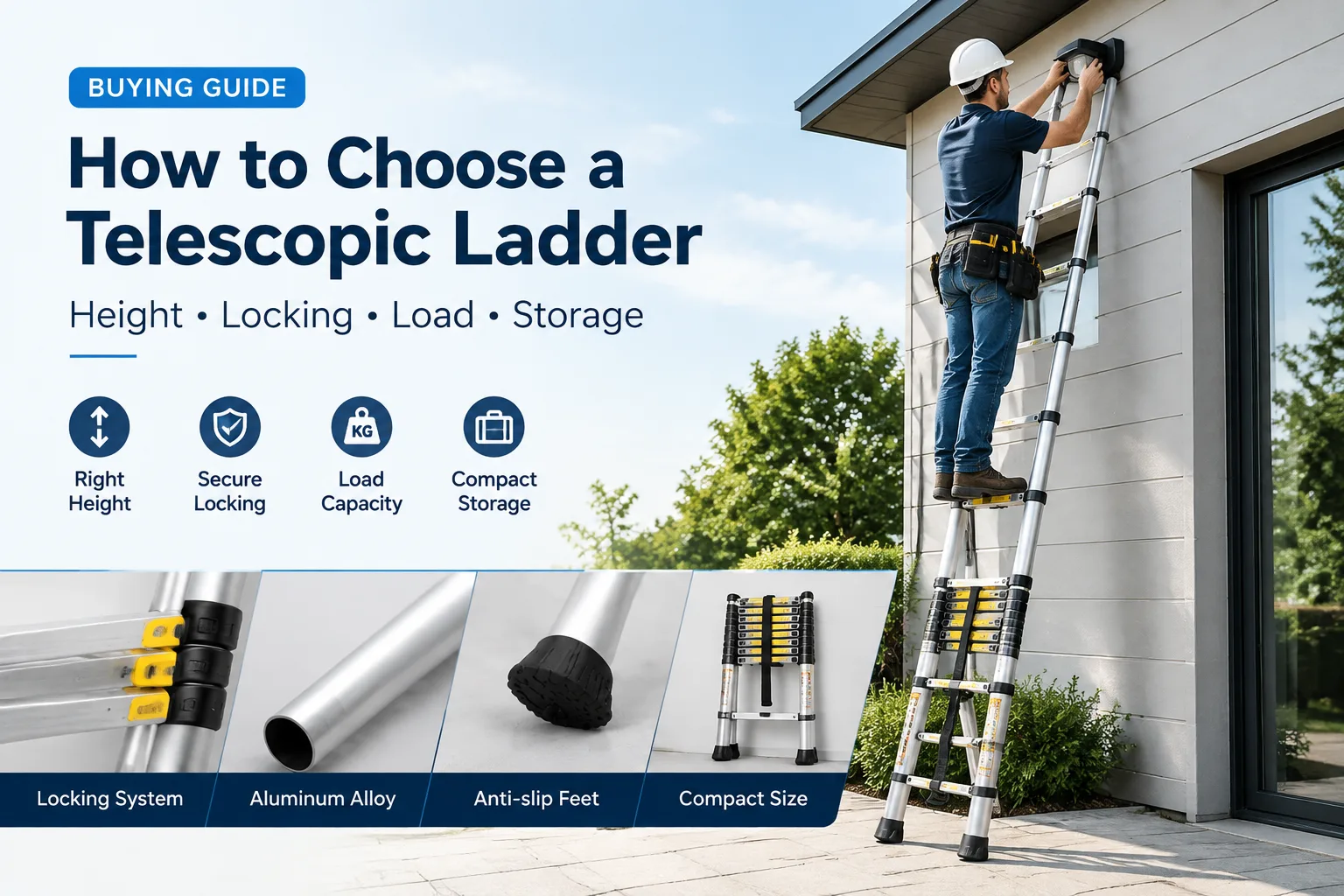
Choosing a telescopic ladder is not simply about finding the tallest model or the lowest price. The right ladder should match your working height, application, storage requirements and expected load.
A telescopic ladder is designed to extend when you need working height and retract when you need to transport or store it. This makes it useful for maintenance teams, contractors, warehouses, homeowners and other users who need a portable access solution.
But with different sizes and configurations available, how do you know which aluminum telescopic ladder is right for your work?
Here are the key factors to consider before making a decision.
1. Start With the Working Height You Actually Need
The first question to ask is not "How tall is the ladder?"
Instead, ask:
How high do I actually need to work?
A telescopic ladder may be available in several extended heights, but choosing the longest model is not always the most practical option.
For example, a ladder used for:
-
Window maintenance
-
Ceiling work
-
Lighting installation
-
Warehouse inspection
-
Roof access
-
Outdoor maintenance
may require different working heights.
Our telescopic ladder range can be produced in different size options, with extended heights ranging from approximately 4.1 m to 11.3 m, depending on the model.
Choosing a suitable height helps avoid carrying unnecessary ladder length while still providing the access needed for the job.
2. Consider the Retracted Size
One of the main reasons users choose a telescoping ladder is portability.
When fully extended, a ladder provides the height needed for work. When retracted, the overall length becomes much more compact, making transportation and storage easier.
This is especially useful for:
-
Service vehicles
-
Garages
-
Workshops
-
Warehouses
-
Tool rooms
-
Small storage areas
Our available models have retracted heights of approximately 2.57 m to 6.17 m, depending on the selected ladder size.
For buyers comparing different models, it is important to consider both measurements:
Extended height = working requirement
Retracted height = transportation and storage requirement
3. Choose the Right Ladder Material
Material has a direct influence on the weight, handling and durability of a ladder.
For portable telescopic ladders, aluminum alloy is commonly selected because it provides a practical balance between strength and weight.
An aluminum telescopic ladder can be easier to:
-
Carry between work areas
-
Load into a service vehicle
-
Move around a warehouse
-
Store after use
-
Set up for routine maintenance
However, material should always be considered together with the ladder's construction, tube dimensions, locking system and rated load capacity.
The lightest ladder is not automatically the right ladder for every application.
4. Check the Locking System
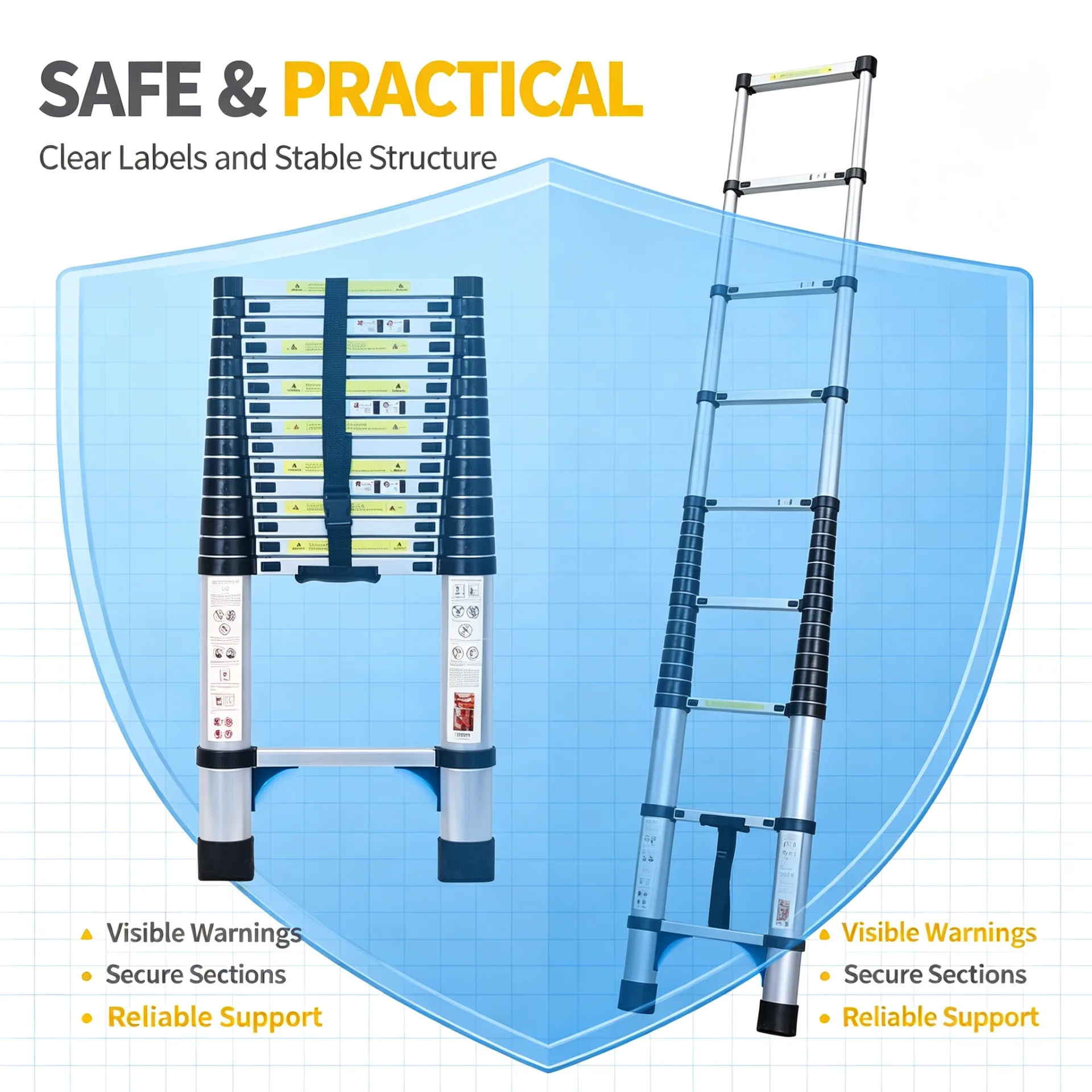
The locking system is one of the most important parts of a telescopic ladder.
Unlike a fixed ladder, a telescopic ladder consists of multiple sections that extend and retract. These sections need to remain securely positioned when the ladder is being used.
When comparing models, pay attention to:
-
Independent section locking
-
Locking mechanism design
-
Visibility of the lock position
-
Smooth extension and retraction
-
Protection against accidental movement
A well-designed telescopic ladder should make it clear whether the sections are properly locked before use.
For buyers sourcing ladders for distribution or professional applications, the locking mechanism should be one of the first product details to inspect.
5. Look at the Load Capacity
Load capacity is another important specification.
Remember that the working load is not only the user's body weight. It may also include tools, equipment and other items carried while working.
When selecting a telescopic ladder, check the manufacturer's specified load capacity and make sure it is appropriate for the intended application.
For wholesale and OEM buyers, load capacity can also be customized according to the product design and target market requirements.
Instead of choosing a ladder simply because it has a large advertised number, compare the load rating with the actual construction and intended use.
6. Pay Attention to the Ladder Feet
The bottom of the ladder has an important role in maintaining contact with the ground.
A telescopic ladder should have properly designed anti-slip feet that provide good contact with the supporting surface.
Rubber feet can help:
-
Improve grip
-
Reduce unwanted movement
-
Protect the floor surface
-
Provide more stable ground contact
The ladder should still be positioned on a suitable, firm and level surface according to the manufacturer's instructions.
7. Think About How the Ladder Will Be Used
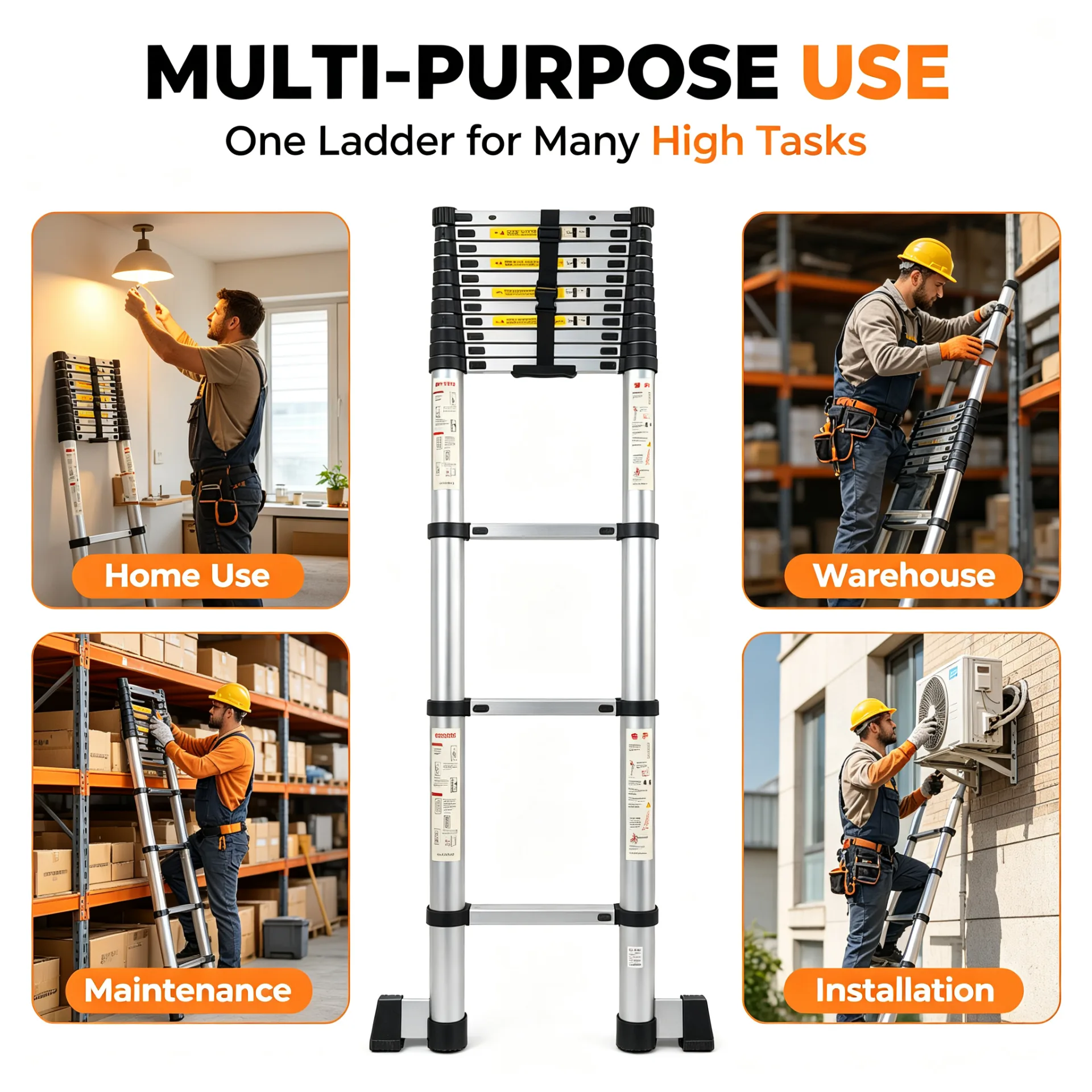
The same telescopic ladder may be suitable for several applications, but the required specifications can be different.
Home Maintenance
For homeowners, common tasks include:
-
Window cleaning
-
Ceiling maintenance
-
Light installation
-
Roof inspection
-
General repairs
Portability and compact storage are often important for these applications.
Warehouse Use
Warehouse workers may need a ladder for:
-
Shelf access
-
Equipment inspection
-
Facility maintenance
-
Stock checking
-
Installation work
In these environments, durability, height and ease of movement become important considerations.
Construction and Maintenance
Contractors and maintenance teams may carry ladders between different work locations.
A portable telescopic ladder can reduce transportation and storage difficulties when the working environment requires frequent movement.
Outdoor Work
Telescopic ladders can also be used for:
-
Gardening
-
Building maintenance
-
Exterior cleaning
-
Roof-related work
-
General outdoor repairs
For outdoor applications, buyers should consider the material, surface condition, weather exposure and other environmental requirements.
8. Compare the Ladder Size With Your Storage Space
A ladder may perform well during use but still be inconvenient if it is difficult to store.
Before ordering, measure the available storage area.
Consider:
Where will the ladder be stored?
How will it be transported?
Will it need to fit inside a vehicle?
How often will it be moved?
These questions are particularly important for contractors, maintenance companies and distributors.
The compact retractable structure of a telescopic ladder makes it easier to integrate into storage and transportation systems than many long fixed ladders.
9. Check the Ladder Before Every Use
Choosing the correct model is only one part of ladder safety.
Before using a telescopic ladder, users should inspect the main working components according to the manufacturer's instructions.
Pay attention to:
-
Rungs
-
Locking mechanisms
-
Aluminum tubes
-
Rubber feet
-
Connections
-
Visible damage or deformation
The ladder should be fully positioned and locked according to the product instructions before climbing.
For telescopic designs, particular attention should be paid to the locking condition of the extended sections.
10. What Size Telescopic Ladder Do You Need?
There is no single size that is suitable for every user.
A practical way to select a telescopic ladder is to work through three questions:
Step 1: What is my required working height?
Determine the highest point you need to access.
Step 2: How often will I transport the ladder?
If the ladder needs to be moved frequently, retracted size and overall weight become more important.
Step 3: Where will I store it?
Measure the available storage space before selecting the model.
This simple process can help you narrow down the right telescopic ladder size instead of choosing based only on maximum height.
Telescopic Ladder vs. Traditional Extension Ladder
A telescopic ladder and a traditional extension ladder can both provide access to higher working areas, but their designs are different.
A traditional extension ladder generally consists of longer overlapping sections, while a telescopic ladder uses multiple sections that retract into a compact form.
The main advantage of a telescopic design is portability.
It can be a practical option when users need to:
-
Move the ladder frequently
-
Save storage space
-
Transport it in a vehicle
-
Adjust the ladder to different heights
For larger or specialized projects, however, users should select the ladder type according to the specific working environment and manufacturer recommendations.
What Makes a Good Aluminum Telescopic Ladder?
When comparing different products, do not focus on only one specification.
A practical aluminum telescopic ladder should be evaluated as a complete system.
Consider:
-
Aluminum alloy construction
-
Available working height
-
Retracted height
-
Load capacity
-
Locking mechanism
-
Anti-slip feet
-
Portability
-
Storage requirements
-
Intended application
-
Quality inspection
The combination of these factors determines whether a ladder is suitable for a particular market or working environment.
OEM Telescopic Ladder Options for Different Markets
For distributors, importers and ladder suppliers, product selection is often different from purchasing a ladder for personal use.
Different markets may require different:
-
Ladder heights
-
Product specifications
-
Packaging
-
Labels
-
Logos
-
Load ratings
-
Product configurations
As a telescopic ladder manufacturer, we support OEM requirements for customers who need different specifications for their target markets.
Our telescopic ladder models can be developed for applications ranging from home maintenance to commercial and industrial use.
Final Thoughts
Choosing the right telescopic ladder starts with understanding the job rather than simply choosing the tallest model.
Working height, retracted size, aluminum construction, locking system, load capacity, anti-slip feet and storage requirements should all be considered before making a decision.
For users who need a portable ladder that can extend to different working heights while taking up less storage space when retracted, an aluminum telescopic ladder can be a practical solution.
If you are sourcing telescopic ladders for distribution, wholesale or OEM projects, contact us to discuss available sizes, specifications and customization options.
Need a Telescopic Ladder for Your Market?
Contact us for product specifications, OEM options and factory quotation.